

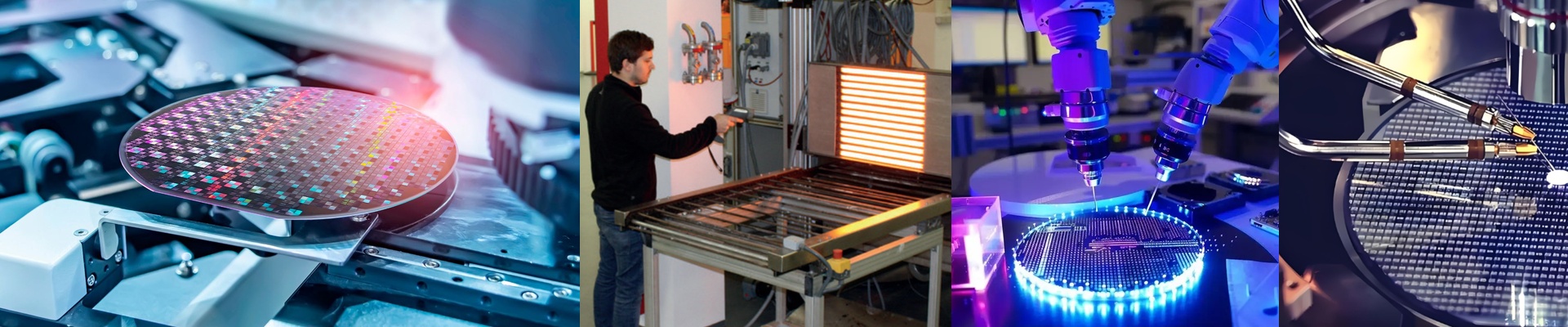
On the fab floor, the RTP tool is anything but background noise. It’s the thermal metronome that sets the pace for photoresist bake, activation, and anneal—every single run. When the halogen lamp stack starts to drift, the temperature profile follows right along. Soft bake loses repeatability. Hard bake misses the mark. Across the lot, CD control and film stress start to wander. Downtime is only part of the cost. Re-qualification eats into planned maintenance windows, and every unplanned swap brings risk: particle generation, connector arcing, quartz window contamination—and the subtle drift that shows up later as a shift in electrical test. You don’t need a new machine. You need a lamp replacement that behaves like the original—by spec, by behavior, and by process outcome.
What matters, technically
Halogen lamps in RTP aren’t just heaters. They’re short-wave, near-infrared radiant sources, engineered to couple energy efficiently into the wafer and keep the chamber environment stable. The replacement has to preserve the original thermal boundary conditions. We build the replacement lamp stack around the physics that actually matter in RTP:
- Spectral output and response: Short-wave NIR matches the absorption profile of silicon and typical process stacks, giving you fast ramp rates without overshoot. The payoff is predictable thermal coupling—consistent from lamp to lamp.
- Thermal uniformity control: Filament geometry and spacing are held to tight tolerances so the radiant field maps repeatably across the wafer. In production, that means the uniformity profile stays stable—no new hot spots.
- Temperature repeatability: Stabilized filament support and repeatable end-seal geometry reduce drift over lamp life. Process engineers see setpoint attainment that holds shift-to-shift, lot-to-lot.
- Cleanroom compatibility: The assembly is built for Class 1–100 environments. Materials are chosen to minimize outgassing and particle shedding, and the mechanical interfaces are designed to keep debris out during handling.
- Mechanical interchangeability: Dimensions, envelope, and terminations match the OEM footprint. No custom adapter work—just a direct fit with documented interface control.
- Electrical integrity: Terminations and internal joints are rated for the expected current density and thermal cycling. The focus is stable contact resistance and reliable ignition behavior through repeated ramp profiles. Every spec is chosen to preserve the process thermal budget. If the lamp changes how heat arrives, the process changes—even when the temperature reads correct at one point.
Why this works in practice
In semiconductor RTP, the only thing that counts is what the wafer experiences, consistently. Photoresist processing doesn’t forgive much. Soft bake sets solvent removal and film stress. Hard bake stabilizes the image before etch or implant. If the bake profile deviates—even a few degrees across the wafer—you’ll see it as edge bead, CD shift, and yield loss that’s expensive to chase down. Our replacement lamp stack is built to keep the process signature unchanged:
- Wafer-level thermal uniformity: The radiant field is engineered to deliver a repeatable temperature distribution. When matched to the chamber reflector and window stack, the system keeps within-wafer variation under control.
- Photoresist bake precision: Soft bake and hard bake profiles hit setpoint with minimal overshoot and settle into a stable steady state. The result is consistent film thickness and stress—repeatable across shifts and across lamp replacements.
- Zero particle generation in practice: The lamp assembly is built to avoid particulate shedding during operation and during swap-in. Particle count isn’t a dashboard vanity metric—it’s a yield lever.
- 24/7 reliability behavior: The lamp stack is validated for sustained operation under repeated rapid thermal cycles. The target is long life with stable output, so you spend less time swapping parts and more time running lots.
- Process repeatability: When the lamp behaves like the reference, qualification cycles get shorter. You don’t have to re-tune the recipe to accommodate a new “personality.” Energy use gets addressed the same way—by engineering efficiency, not by talking about it. A well-matched lamp stack transfers energy into the wafer with less wasted heat in the surroundings. That cuts cooling load and lowers per-lot energy draw. It’s measurable, and it adds up across thousands of cycles. This isn’t about swapping a part. It’s about preserving the process envelope so the fab keeps running the way it was qualified to run.
The details that make the difference
Even a direct-fit replacement needs disciplined handling and commissioning. The lamp is precise, and so is everything around it.
- Installation practice matters: Handle the lamp by the base, not the glass envelope. Use clean, lint-free gloves. Any contamination on the quartz or at the seals becomes a particle source—and a thermal asymmetry.
- Alignment and seating: The lamp has to seat exactly as designed. Misalignment changes the radiant field geometry and can shift uniformity. Confirm mechanical stops and fastener torque against the interface spec.
- Electrical connections: Clean mating surfaces and verified torque keep contact resistance stable and prevent localized heating at the terminal. Loose connections turn into hot spots and shorten lamp life.
- Commissioning after swap: Even with a matched replacement, run a short qualification lot after installation. Confirm temperature uniformity, ramp behavior, and steady-state stability against your existing control plan.
- One practical constraint: The lamp stack is engineered to match the original interface, but actual life in your facility depends on ramp rates, duty cycle, and ambient conditions. High-frequency cycling is harder on any lamp. Plan replacement intervals around your process profile, not a one-size-fits-all claim. If you’re running RTP tools and the halogen lamp stack is due for replacement, the decision isn’t “cheap versus expensive.” It’s about whether you want to introduce variability or keep the process fixed. We supply an RTP halogen lamp replacement built to match the thermal, mechanical, and cleanroom requirements of semiconductor equipment, delivering validated equivalence to the original specification. The goal is straightforward: keep the tool running the process it was qualified to run, with fewer interruptions and predictable performance.